

Buying an off-plan villa in Bali can offer an attractive entry price, flexible payment stages and a wider choice of units. It also involves more risk than purchasing a completed property.
At the reservation stage, the villa may exist only as plans, renders, contracts and projected rental figures. The buyer is relying on the developer to secure the land, obtain approvals, complete construction and deliver the property as promised.
That is why due diligence should begin before you reserve. The following 25 checks cover the main legal, technical, financial and operational issues international buyers should review before committing.
Request the Tanoa Investment Pack
Review the available villas, ownership pathways, floor plans and illustrative financial scenarios for Tanoa Ricefields.
Why Due Diligence Matters

A completed villa can be inspected and tested. An off-plan villa cannot.
Investors must therefore assess the project through documents, contracts and independent professional advice. The main risks usually relate to land rights, zoning, construction, payment protection, rental licences, management costs and resale conditions.
Due diligence cannot remove every risk, but it can clarify what you are buying and what happens if the project is delayed, changed or not completed.
Legal and Land Checks

1. Identify the Contracting Company
Confirm the full legal name of the company selling or leasing the villa. Request its registration details, business address, directors and authorised signatories.
The entity receiving your payments should match the entity named in the contract. Your lawyer should establish who is legally responsible for construction, handover, warranties and refunds.
2. Confirm the Developer Controls the Land
The developer may own the land, lease it or operate through an agreement with the registered landowner.
Ask for evidence showing that it has the legal right to build the project, grant rights to buyers, complete the development and appoint a property operator.
3. Verify the Land Certificate
An independent Indonesian legal adviser should verify the original land certificate and confirm:
- Registered owner
- Certificate type
- Land area
- Location
- Ownership history
- Existing restrictions
- Mortgages or registered charges
The certificate should also match the physical project site and the development master plan.
4. Check for Disputes and Claims
Confirm whether the land is affected by mortgages, court proceedings, inheritance claims, unpaid debts, family disputes or previous agreements.
A signed contract may not protect a buyer if another party already holds stronger legal rights over the land.
5. Confirm the Boundaries
Request a current land survey and compare it with:
- The land certificate
- Site plan
- Villa plot
- Internal roads
- Shared facilities
- Pool and garden areas
In a multi-villa development, establish whether your unit is linked to a defined plot or only to contractual rights within a larger parcel.
6. Verify Zoning and Permitted Use
The land must be suitable for the proposed construction and commercial use.
Your advisers should verify:
- Land-use zoning
- Building function
- Tourism or accommodation use
- Height and density limits
- Required setbacks
- Environmental restrictions
Do not assume that your site is legal simply because other villas operate nearby.
7. Confirm Legal Road Access
Physical access is not enough. The villa should have documented and enforceable road access.
Check who owns the road, whether a right of way exists, who maintains it and whether emergency, service and construction vehicles can use it.
Access rights should remain valid for the full term of your property interest.
8. Review the Lease Term
For a leasehold property, confirm:
- Initial lease duration
- Start date
- Extension rights
- Extension pricing method
- Transfer rights
- Inheritance provisions
- Termination conditions
If the lease begins before construction, the usable period after handover may be shorter than the advertised term.
9. Review the Ownership Structure
Foreign investors commonly consider a leasehold arrangement or an eligible company structure such as a PT PMA, depending on the project and intended use.
The chosen structure can affect:
- Taxes
- Rental activity
- Compliance
- Control
- Resale
- Ongoing costs
Obtain independent Indonesian legal and tax advice before paying a non-refundable reservation fee.
Planning and Operational Checks

10. Verify the Building Approval
Ask for evidence that the development has the required building approval, commonly known as a PBG.
Indonesia’s official building-management system identifies the PBG as the approval used for new building construction. The documentation should match the building function, floor area, number of floors and plans being marketed to buyers.
Any significant difference between the approved plans and the marketed villa should be explained before you reserve.
11. Confirm Completion Certification
Ask who will obtain the certificate confirming that the completed building is suitable for use, commonly known as the SLF.
Official guidance describes the SLF as the certificate issued by the local government to confirm a building’s functional suitability before it is used.
The contract should explain:
- Who applies for it
- Who pays the cost
- When it must be obtained
- Whether handover can occur without it
- What happens if certification is delayed
12. Check Rental and Business Licences
A villa may be legally constructed but still lack the approvals required for short-term accommodation.
Indonesia’s current business classification includes villa activity within the provision of short-term accommodation.
Confirm:
- Which entity will operate the villa
- Which business licences are required
- Whether the operator is registered
- Whether the licence covers the specific property
- Who is responsible for renewals
Do not assume that property ownership automatically includes permission to operate tourist accommodation.
13. Review Water, Drainage and Waste Systems
Ask how the development will manage:
- Water supply
- Water storage
- Wastewater
- Septic systems
- Stormwater
- Flood risk
- Waste collection
- Pool discharge
These checks are especially important near rice fields, rivers and low-lying land. Poor infrastructure can increase maintenance costs and damage the guest experience.
Developer and Construction Checks

14. Research the Developer
Review the developer’s completed and current projects.
Where possible:
- Visit a finished development
- Speak with previous buyers
- Inspect the construction quality
- Check whether projects were delivered on time
- Review how defects were handled
A limited track record does not automatically make a project unsuitable, but it increases the importance of strong contracts and payment protections.
15. Understand How the Project Is Funded
Ask whether construction is financed through developer capital, external funding, buyer instalments or a combination of sources.
Projects depending heavily on future sales may face greater risk if reservations slow down.
Buyers should understand whether:
- The land has been secured
- Construction funding is available
- Buyer payments are allocated to the project
- Construction can continue if sales targets are not achieved
16. Review the Contractor
Identify the construction company and review its:
- Registration
- Relevant experience
- Previous projects
- Technical team
- Insurance
- Safety procedures
The developer’s agreement with the contractor should clearly address scope, timeline, quality, defects, delays and termination.
17. Check Plans and Specifications
Renders are marketing tools. They do not define the final legal product.
The contract should include or reference:
- Floor plans
- Elevations
- Electrical and plumbing plans
- Pool details
- Furniture schedule
- Appliance list
- Finishes
- Landscaping
- Technical specifications
Avoid vague descriptions such as “premium materials” without measurable details.
Important finishes should identify the brand, material, dimensions or an approved equivalent.
18. Review Structural and Site Conditions
A technical adviser should assess whether the foundations, structure, waterproofing and drainage are suitable for the site.
Depending on the project, this may include:
- Soil conditions
- Structural calculations
- Retaining walls
- Roof design
- Pool engineering
- Seismic considerations
- Electrical capacity
- Ventilation
- Air conditioning
The goal is to confirm that the villa is designed for Bali’s tropical climate and the actual conditions of the land.
19. Confirm the Construction Timeline
The contract should include measurable milestones, a target completion date and a final long-stop date.
It should also explain:
- Permitted extensions
- Force majeure
- Delay penalties
- Buyer termination rights
- Refund conditions
- Notification procedures
A delivery date offers limited protection when the contract provides no meaningful remedy for delay.
Contract and Payment Checks
20. Review the Reservation Agreement
Before paying, confirm:
- Reservation amount
- Unit being held
- Reservation period
- Refund conditions
- Due diligence period
- Deadline for the main contract
- Account receiving the funds
The agreement should state what happens if legal or technical checks identify a serious problem.
Never assume a reservation payment is refundable unless the written terms say so.
21. Link Payments to Construction Progress
Where possible, instalments should be linked to verifiable milestones such as:
- Foundation completion
- Structural completion
- Roofing
- Interior finishes
- Practical completion
- Handover
Ask who certifies progress and whether an independent inspector can verify each stage.
Avoid paying most of the purchase price before the villa reaches a comparable level of completion.
22. Confirm Inspection and Warranty Rights
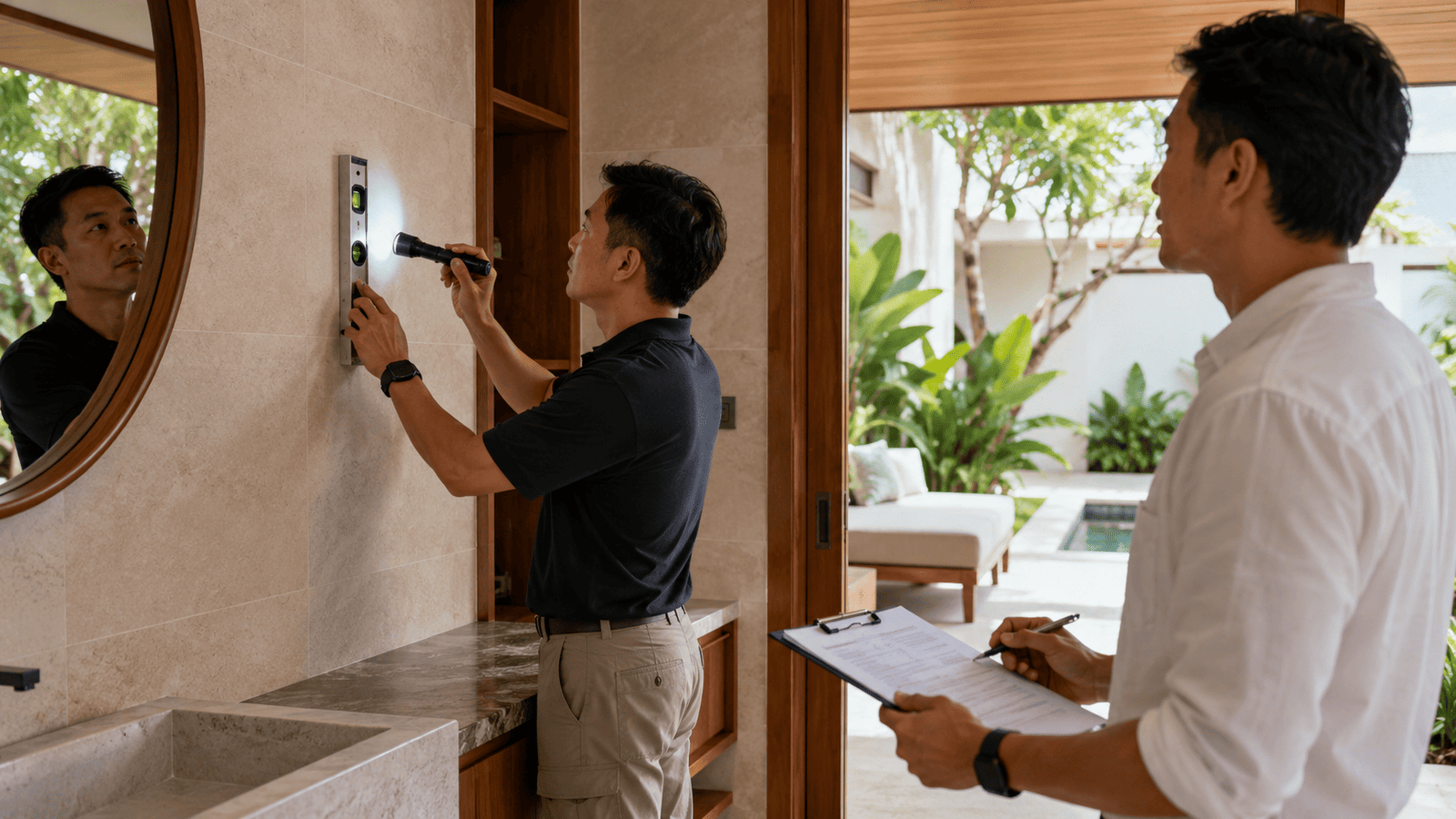
The contract should allow an independent inspection before final acceptance.
It should cover:
- Written snagging list
- Deadline for corrections
- Reinspection
- Defects-liability period
- Structural warranty
- Equipment warranties
- Transfer of supplier documents
The buyer should not lose all rights simply by accepting the keys.
Financial and Commercial Checks

23. Calculate the Full Acquisition Cost
The advertised price may not include every expense required to complete and operate the villa.
Prepare a full budget covering:
- Legal and notary fees
- Taxes
- Company setup, if applicable
- Furniture and appliances
- Utility connections
- Insurance
- Management setup
- Initial working capital
- Currency-transfer costs
- Maintenance reserves
Confirm what is included, what is provisional and whether the contract permits price adjustments.
A low advertised price may become less attractive once every acquisition and operational cost is included.
24. Test the Rental Projections
If the villa is marketed as a managed investment, review the management agreement and financial model.
Confirm:
- Management fee
- Booking-platform commissions
- Staff costs
- Utilities
- Maintenance
- Marketing charges
- Owner-stay rules
- Tax assumptions
- Replacement reserves
The projection should clearly separate gross booking revenue from net operating income.
Test at least three scenarios:
Conservative scenario
Lower occupancy, lower nightly rates and higher operating costs.
Expected scenario
Realistic assumptions supported by comparable properties.
Optimistic scenario
Strong occupancy and pricing without presenting the outcome as guaranteed.
The investment should remain understandable when occupancy or nightly rates are lower than forecast.
25. Review Resale and Exit Rights
Before buying, understand how you can assign, transfer or sell your interest.
Review:
- Assignment rights before completion
- Resale restrictions
- Transfer fees
- Developer approval
- Remaining lease term
- Extension rights
- Management contract conditions
- Buyer eligibility
Your exit strategy should be assessed before you enter the investment, not only when you decide to sell.
Documents to Request Before Reserving
Ask for the most relevant documents before paying a reservation fee:
- Developer company documents
- Land certificate
- Landowner or development agreement
- Survey and site plan
- Zoning confirmation
- Road-access documents
- Building approval
- Architectural plans
- Construction schedule
- Draft reservation agreement
- Draft purchase or lease agreement
- Draft management agreement
- Payment schedule
- Rental projections
- Warranty terms
If a document is not yet available, the developer should explain when it will be completed and what rights the buyer has if it is not obtained.
Common Red Flags
Proceed carefully when you encounter:
- Pressure to pay immediately
- Refusal to provide land documents
- Payments to personal accounts
- Unclear zoning or legal access
- Permits described only as “in progress”
- Guaranteed returns without evidence
- Contracts supplied only after payment
- Most of the price due before construction
- No independent inspection rights
- No remedy for serious delays
- Vague construction specifications
- Unclear management fees
- Lease extensions without a pricing method
One issue may have a reasonable explanation. Several unresolved red flags usually justify delaying the reservation.
Final Check Before You Reserve
The best off-plan villa is not necessarily the one with the lowest launch price or highest projected return.
A strong investment decision depends on understanding:
- The land rights
- Building and rental approvals
- Construction obligations
- Payment protections
- Operating costs
- Management conditions
- Completion process
- Resale rights
Before reserving an off-plan villa in Bali, appoint independent legal and technical advisers, review the supporting documents and ensure every important promise appears in the contract.